As an End Of Life Doula who has several areas of specialisation, I work to remain current with changes to regulations and abreast of new information to serve my clients as best I can.
However, I also love history and research, and today I looked back in time with a quiet laugh about the way End Of Life and paperwork are intertwined throughout the course of recorded history. Over the course of this summer I am preoccupied with paperwork myself as I continue to work on becoming a registered Australian celebrant (not required for funerals in Australia at the time of writing, but still), and go through the processes of early preparation for research into End Of Life Doulas in Australia (2018’s project) and tidying up some administrative loose ends with a professional association for Doulas here in Australia. I am often thinking about the bureaucracy of End Of Life in multiple ways as I think about my colleagues, my own requirements and interests, and of course my clients and what they may want or need to know about any particular aspect of the End Of Life planning journey.
Paperwork, therefore, is all around me. Everywhere I look – literally at the moment – I see paperwork of various stripes relating to End Of Life whilst researching paperwork and End Of Life. #MetaphorAlert
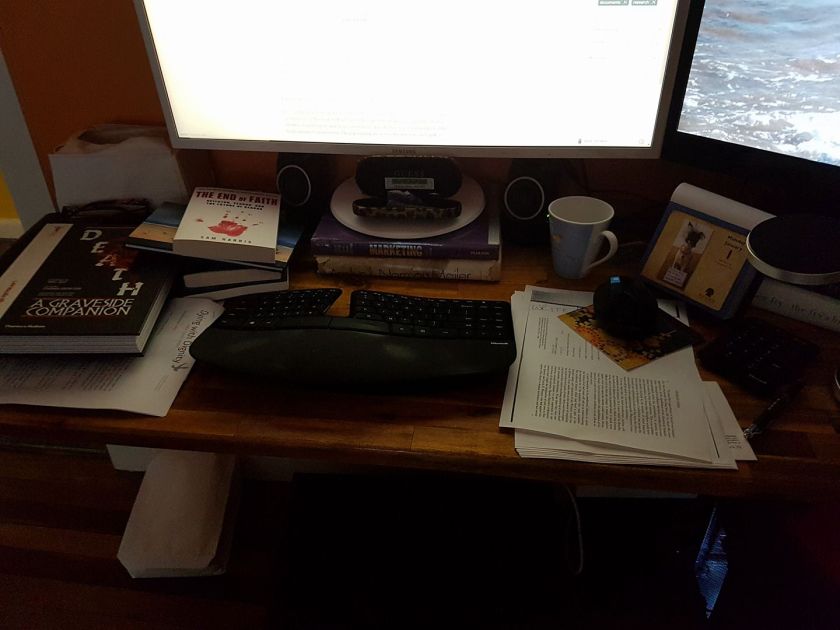
So here are a few interesting tidbits about the intersections of End Of Life and documents. As the ancient Greeks, Chinese, and Egyptians all had flourishing bureaucracies at the beginning of recorded history, I will touch on something from each here:
In 2011 Eleni Pachoumi published an article considering the Greek Magical Papyri and resurrection of the dead, with a focus on the role of the dead as assistant (the idea for Shelley’s Frankenstein came from somewhere), and whether or not manipulation of the body equates to resurrection. The papyri purports to give the directions and spell for resurrection, so death and paperwork can serve both the living and the dead here in interesting ways.
The ancient Egyptians, creators of an excellent bureaucratic system, had a collection of over 200 spells for the scribes to draw from for a papyrus scroll when creating a Book of the Dead for an individual. Instructions for navigating the afterlife were complex and tailored to an person’s preferences and lifestyle in the lived world. In this instance, the scrolls worked primarily to serve the dead in the next world, although there is an argument that the living may have been consoled by the instructions provided in the scroll as well.
Some ancient Greeks (of the Orphic tradition) paid scribes by the letter (Oh! What a time to be a writer!) to create lamellae in gold foil, providing stonking evidence, if there were any doubts, that purchasing one’s way into a better after-life is not a modern claim to fame. Wealthy people would have been virtually guaranteed entry into Paradise as they could afford more fulsome testimony as to the ‘pure’ state of their lives and genealogy in comparison to poorer persons who could not afford many words. Claiming relation to deity was considered desirable and effective in gaining access to the ‘good’ VIP areas of the afterlife in many ancient belief systems, including that of the Greeks. Some theorists consider the lamellae as ‘passports’, exhorting the gods to permit the bearer to enter the better areas including Paradise and the Elysian Fields and striving to ensure that Tartarus (structures of punishment and levels of reward in the afterlife are old constructs, too), whilst others consider that the lamellae were mouth coverings that would ‘speak’* for the individual in the afterlife. The claimed link to the Orphic tradition in the lamellae by some scholars – contested as real by researchers of the ancient world for almost a century now – is a fascinating aspect of this story, but one I will consider in another post as there are also cross-overs to ancient Egypt and it can be somewhat involved…
China, another nation with an admirable bureaucratic system, also has paperwork for the End Of Life, however the paperwork involves etiquette instructions for the intermediary (male head of the family) between the living and the dead. Strict protocols and rituals were involved in this Confucian practice, although the book cited here concerns a more ‘approachable’ translation of the original texts in the 12th century by Chu Hsi, which would have been easier for families at several levels of society to read and follow. Simplified paperwork is a good thing.
We in the 21st century must have the correct paperwork for concluding the End Of Life process; we must follow bureaucratic and administrative processes to the letter in order to ensure that End Of Life is smooth for those remaining behind us. Some of us are not able to move forward in grief or mourning until all the paperwork is finalised, so underestimating the import of planning or lack thereof is to be avoided whenever possible. Sometimes the paperwork takes a long, long time and there is nothing we can do about the timeline, but for family the wait can be excruciating. The relative of a friend died alone from unknown causes, but as soon as foul play (murder, etc.) was ruled out by the Coroner’s office the case fell far down the priority list for processing and releasing the outcomes of testing and autopsy. The family waited for six weeks before finding out the true cause of death and the release of the body for funeral and cremation – the stasis created by the delay in paperwork intensified the struggle the family had in coming to terms with the unexpected death, and altered their mourning journey irreversibly.
Paperwork surrounds us, even when it is not as obvious as the work desk I currently have in front of me the paperwork is still there. Bureaucracy is still implacable. It is sometimes fun for me to think about how paperwork and process at End Of Life have gone together in the past, and I hope it is for you sometimes, too (otherwise why would you have read this far?) – however I also bear in mind that advance planning of as much ‘paperwork’ as possible is essential in our modern society. We can make grieving, mourning, and processing as simple as possible for our loved ones – and it is a very tangible way to caretake our loved ones and those we leave behind after our End Of Life.
Advance planning for your End Of Life will not hasten anything or change anything in negative terms for you and your family; you may be surprised to know that it is often quite the reverse. People who plan their paperwork for End Of Life almost universally experience a better quality of life because the bureaucracy/paperwork is sorted and you are able to focus your time and energy on the projects, people, and events that bring you pleasure.
*On a side note, I myself think about advance planning documents in just this way; our wills, and memorial letters, books, films and artworks ‘speak’ for us even after our End Of Life.

 Dr Annetta Mallon